Expose
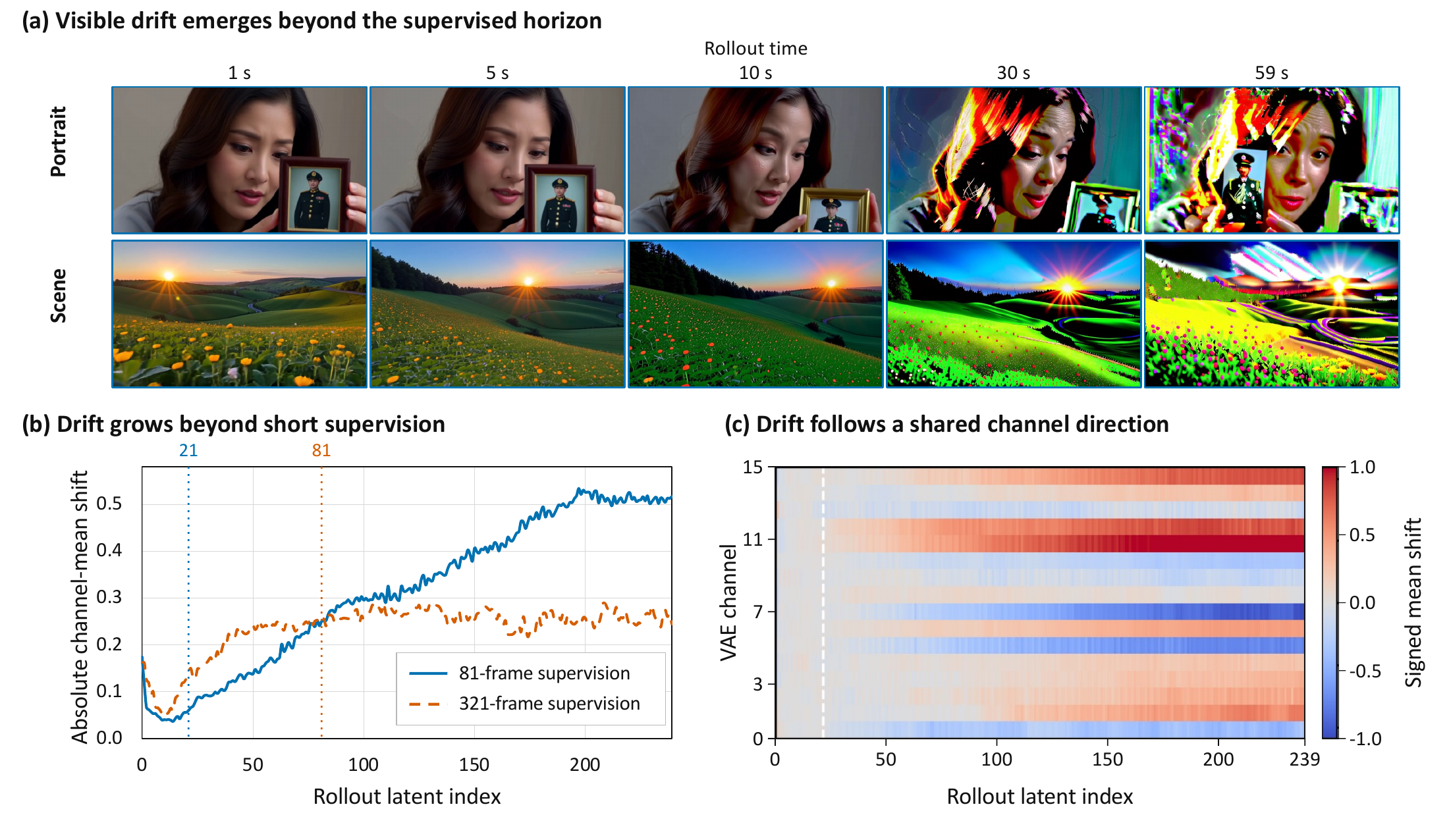
Long on-policy rollouts reveal failure states that short training windows cannot reach.
LONG-HORIZON WORLD MODELING
Scaling Temporal Manifold Matching for Long-Horizon World Rollout
1 AMAP, Alibaba Group2 Tsinghua University
LongForcing extends distribution matching from short windows to long self-generated trajectories under long-horizon teacher guidance.
01 / 03
Matching short video windows leaves the relationships between distant moments underdetermined. Local plausibility alone does not specify how a world should evolve.
VIDEO OVERVIEW
A short introduction to our motivation, method, and results.
01 / ABSTRACT
Short-window matching does not determine a long rollout.
Autoregressive video diffusion turns fixed-length synthesis into streaming world rollout. Yet, when generated chunks are recursively reused as context, small errors move the model into states that were never supervised and drift compounds.
LongForcing preserves short teacher-forcing and ODE-distillation stages, then scales distribution matching to long on-policy student rollouts under an extended-horizon bidirectional teacher, without changing the architecture or inference cost.
LongForcing reaches 85.52 VBench Quality and improves first-person 60-second WorldRoamBench Action by 23.9 points in the 1.3B horizon ablation. Qualitative 5B stress tests sample rollouts up to 24 hours, far beyond the training horizon.
02 / METHOD
LongForcing retains short-horizon teacher forcing and causal ODE distillation. In the final DMD stage, the student generates a longer causal path; the frozen real-score teacher and online fake-score network evaluate the whole path bidirectionally at a shared noise level.
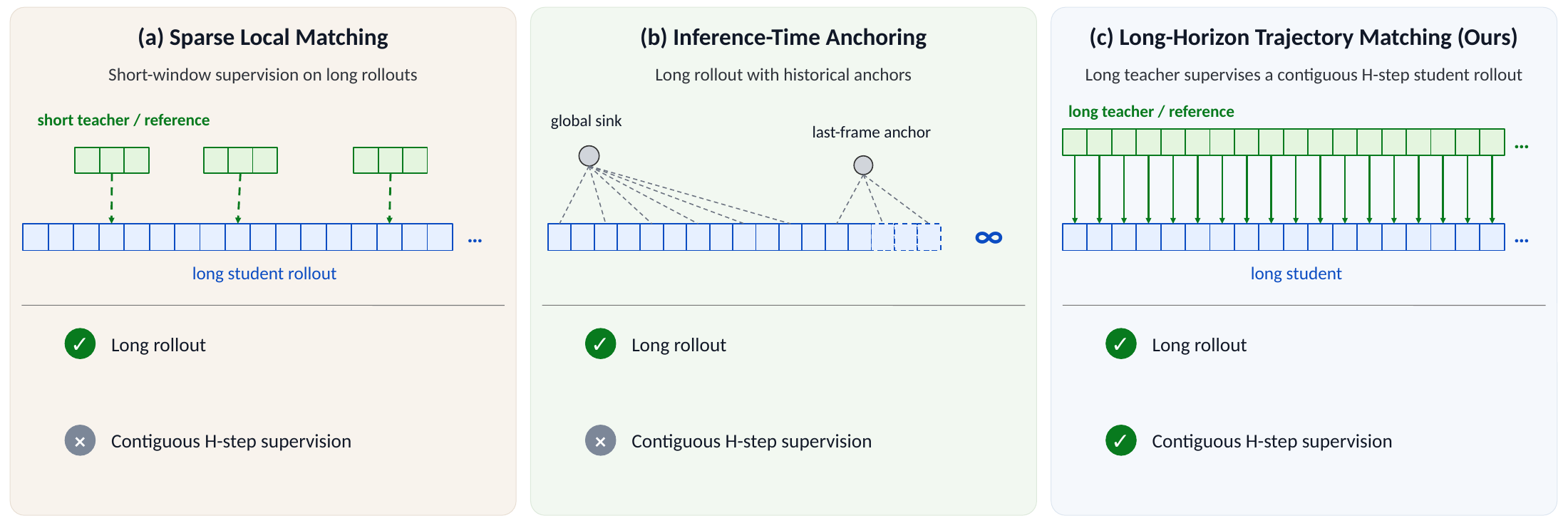
Long on-policy rollouts reveal failure states that short training windows cannot reach.
A long-horizon teacher scores a contiguous student path rather than sparse local fragments.
Update the few-step causal student using standard DMD. Its architecture and inference procedure remain unchanged.
Interactive models use Wan2.2-5B and Wan2.1-1.3B. DMD uses 321-frame rollouts and trains for 1,000 steps on eight GPUs with global batch size 8. Longer DMD paths increase training compute and memory; inference operations stay unchanged.
03 / EXPERIMENTS
We evaluate 60-second interactive world rollouts and text-to-video generation. The 5B third-person comparison uses control-rate-weighted scores; the 1.3B first-person horizon ablation reports unweighted scores.
60-SECOND THIRD-PERSON · 5B
Control-rate-weighted Action; highest among the open-source models compared in the paper.
5-SECOND VBENCH
+0.93 points over Causal Forcing at matched inference cost.
30-SECOND VBENCH-LONG
Highest Total and Quality among the compared methods; +1.78 Total and +0.55 Quality over Causal Forcing.
All scores are on a 0–100 scale. For normalized raw score s and control rate p, higher-is-better scores are 100ps. Ctrl. is 100p; Aesthetic Drift is 100[1 − p(1 − d)], where d is normalized raw drift.
| Model | Size | Action ↑ | Ctrl. ↑ | Partial acc. ↑ | Trajectory ↑ | Visual ↑ | Aesthetic ↑ | Aesth. drift ↓ | Imaging ↑ |
|---|---|---|---|---|---|---|---|---|---|
| Proprietary models | |||||||||
| Genie 3 | — | 69.73 | 79.80 | 65.75 | 73.70 | 56.26 | 48.11 | 32.08 | 45.30 |
| HappyOyster | — | 84.02 | 96.97 | 80.48 | 87.57 | 65.63 | 59.10 | 20.61 | 47.44 |
| Open-source models | |||||||||
| LingBot-World | 14B | 18.81 | 23.23 | 18.50 | 19.12 | 15.99 | 14.32 | 81.70 | 13.84 |
| HY-World 1.5 | 8B | 24.92 | 29.29 | 24.57 | 25.28 | 19.11 | 17.52 | 79.48 | 16.52 |
| LingBot-World v2 | 14B | 36.09 | 40.40 | 35.35 | 36.84 | 28.42 | 25.61 | 68.75 | 25.04 |
| LongForcing | 5B | 76.81 | 87.88 | 73.74 | 79.89 | 57.89 | 51.69 | 31.93 | 48.26 |
LongForcing-5B controls 87 of 99 cases (87.88%), versus 40 of 99 (40.40%) for LingBot-World v2. Rankings are restricted to the models reported here.
Unweighted scores with a fixed 1.3B backbone. Increasing the DMD horizon from 81 to 321 frames raises Action from 64.39 to 88.26 (+23.87 points) and reduces Aesthetic Drift from 56.58 to 42.37.
| DMD frames | Training span | Action ↑ | Strict acc. ↑ | Partial acc. ↑ | Trajectory ↑ | Visual ↑ | Aesthetic ↑ | Aesth. drift ↓ | Imaging ↑ |
|---|---|---|---|---|---|---|---|---|---|
| 81 | ~5s | 64.39 | 42.89 | 63.01 | 87.27 | 45.05 | 39.81 | 56.58 | 46.40 |
| 161 | ~10s | 56.16 | 43.21 | 50.00 | 75.28 | 47.01 | 41.06 | 60.18 | 52.29 |
| 241 | ~15s | 83.39 | 78.24 | 85.14 | 86.78 | 55.19 | 49.93 | 43.30 | 50.25 |
| 321 | ~20s | 88.26 | 85.16 | 90.56 | 89.05 | 56.30 | 51.61 | 42.37 | 50.84 |
5-second VBench and 30-second VBench-Long are separate evaluation protocols. Higher is better for Total, Quality, and Semantic scores.
| Protocol | Model | Total ↑ | Quality ↑ | Semantic ↑ |
|---|---|---|---|---|
| VBench · 5s | CausVid | 81.33 | 83.98 | 70.72 |
| VBench · 5s | Self Forcing | 83.74 | 84.48 | 80.77 |
| VBench · 5s | Causal Forcing | 84.04 | 84.59 | 81.84 |
| VBench · 5s | LongForcing | 84.56 | 85.52 | 80.72 |
| VBench-Long · 30s | LongLive | 82.80 | 83.21 | 81.17 |
| VBench-Long · 30s | Self Forcing | 81.49 | 82.67 | 76.77 |
| VBench-Long · 30s | Causal Forcing | 81.05 | 83.44 | 71.52 |
| VBench-Long · 30s | LongForcing | 82.83 | 83.99 | 78.19 |
Each rollout length uses its corresponding separately trained teacher checkpoint. These configurations change both rollout length and teacher checkpoint; improvements are not monotonic across horizons.
| DMD frames | Training span | 5s Total ↑ | 30s Total ↑ | 30s Quality ↑ | 30s Semantic ↑ | 30s Dynamic ↑ |
|---|---|---|---|---|---|---|
| 81 | ~5s | 84.36 | 81.87 | 83.71 | 74.54 | 58.15 |
| 161 | ~10s | 83.76 | 78.02 | 81.59 | 63.77 | 56.67 |
| 241 | ~15s | 84.38 | 79.18 | 83.75 | 60.87 | 94.91 |
| 321 | ~20s | 84.56 | 82.83 | 83.99 | 78.19 | 60.93 |
TIME-RESOLVED EVIDENCE
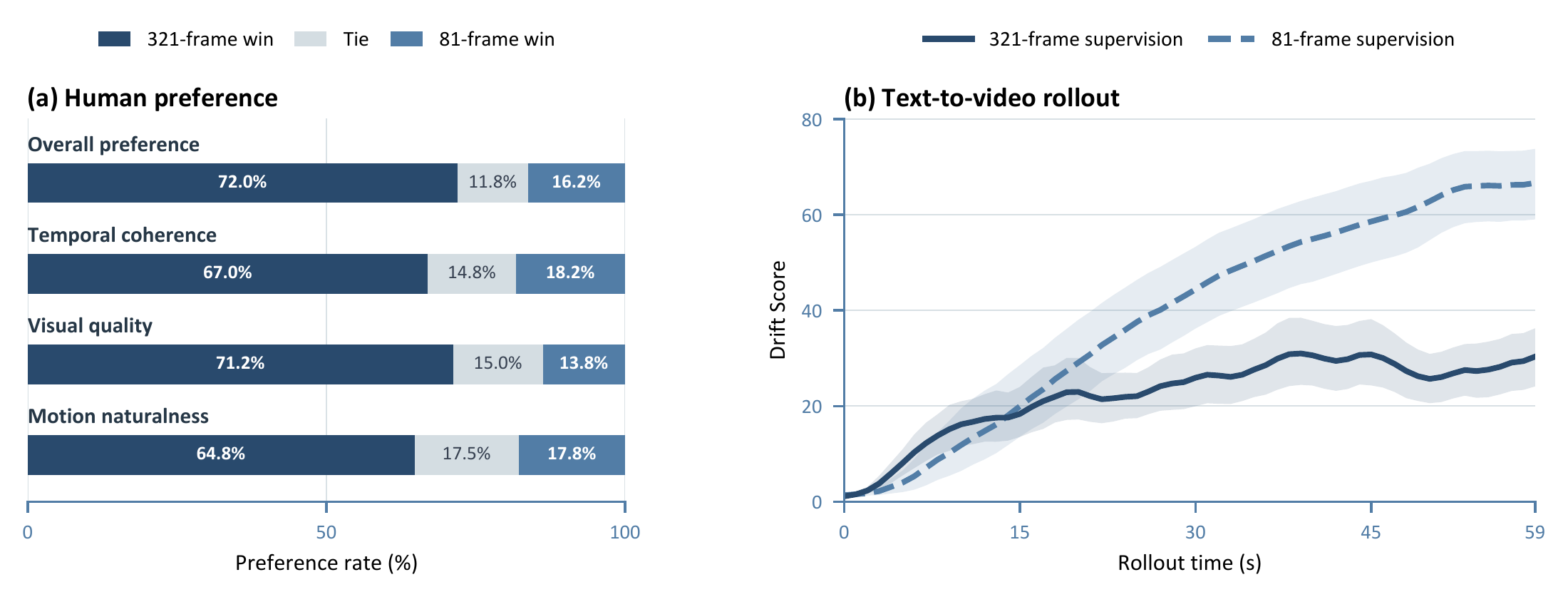
At 59 seconds, 321-frame supervision reduces the mean Drift Score from 67.46 to 31.91. Human evaluators also prefer the long-horizon model across overall quality, temporal coherence, visual quality, and motion naturalness.
400 judgments per criterion; 16.2% prefer the 81-frame model and 11.8% are ties.
04 / QUALITATIVE RESULTS
Interactive rollouts from LongForcing-5B and selected paper figures. Videos are qualitative examples, separate from the benchmark evaluation.
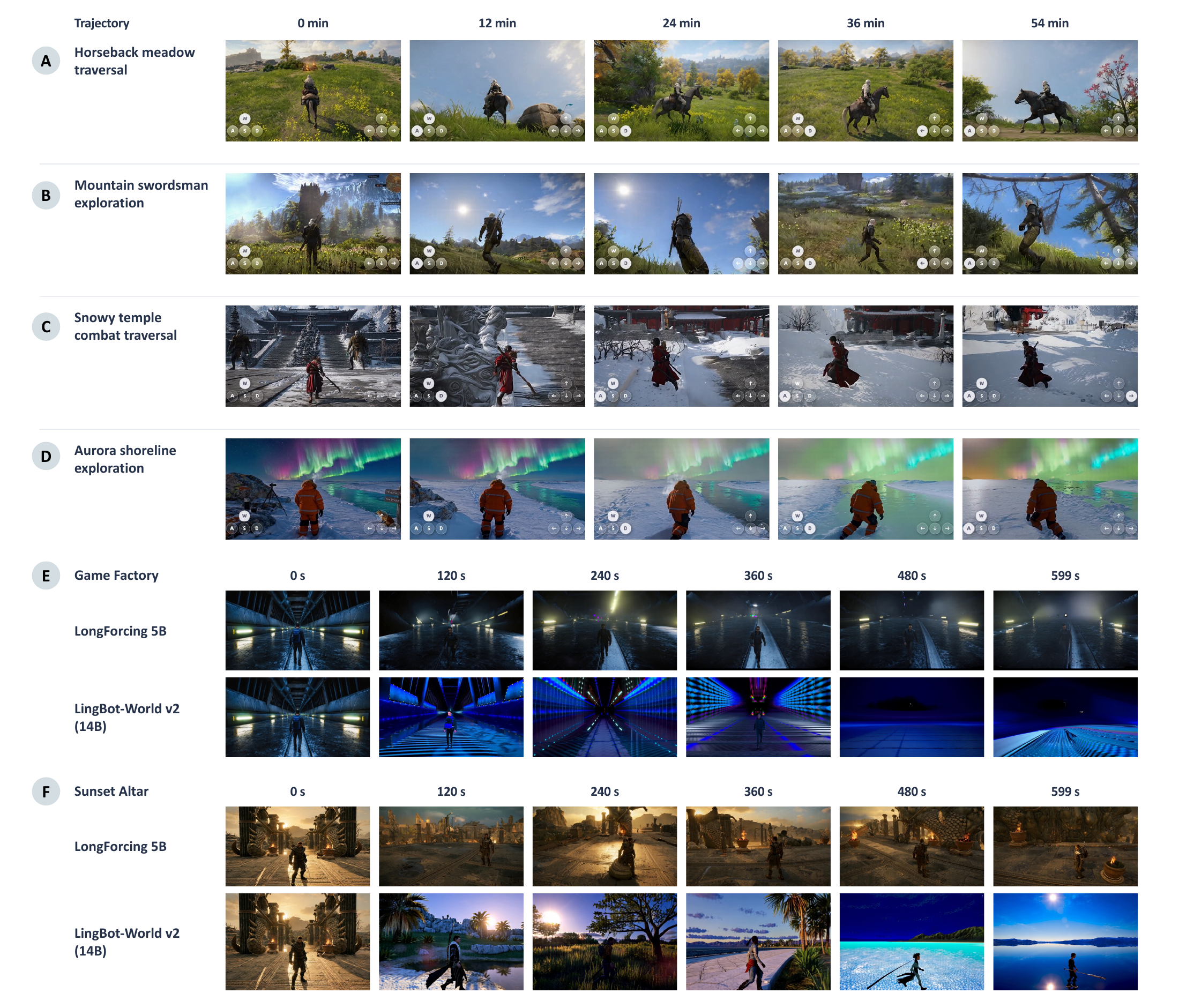
Each one-minute preview covers the complete 600-second source trajectory at 10× speed. These examples illustrate long-horizon behavior; they do not establish uninterrupted stability or matched action trajectories across methods.
Eight 30-second examples across first- and third-person views. Each video plays at its original speed with the recorded WASD overlay retained.
These short examples illustrate scene variety and are separate from the quantitative evaluation and long-horizon demonstrations above.
Six trajectories sampled over extended generation
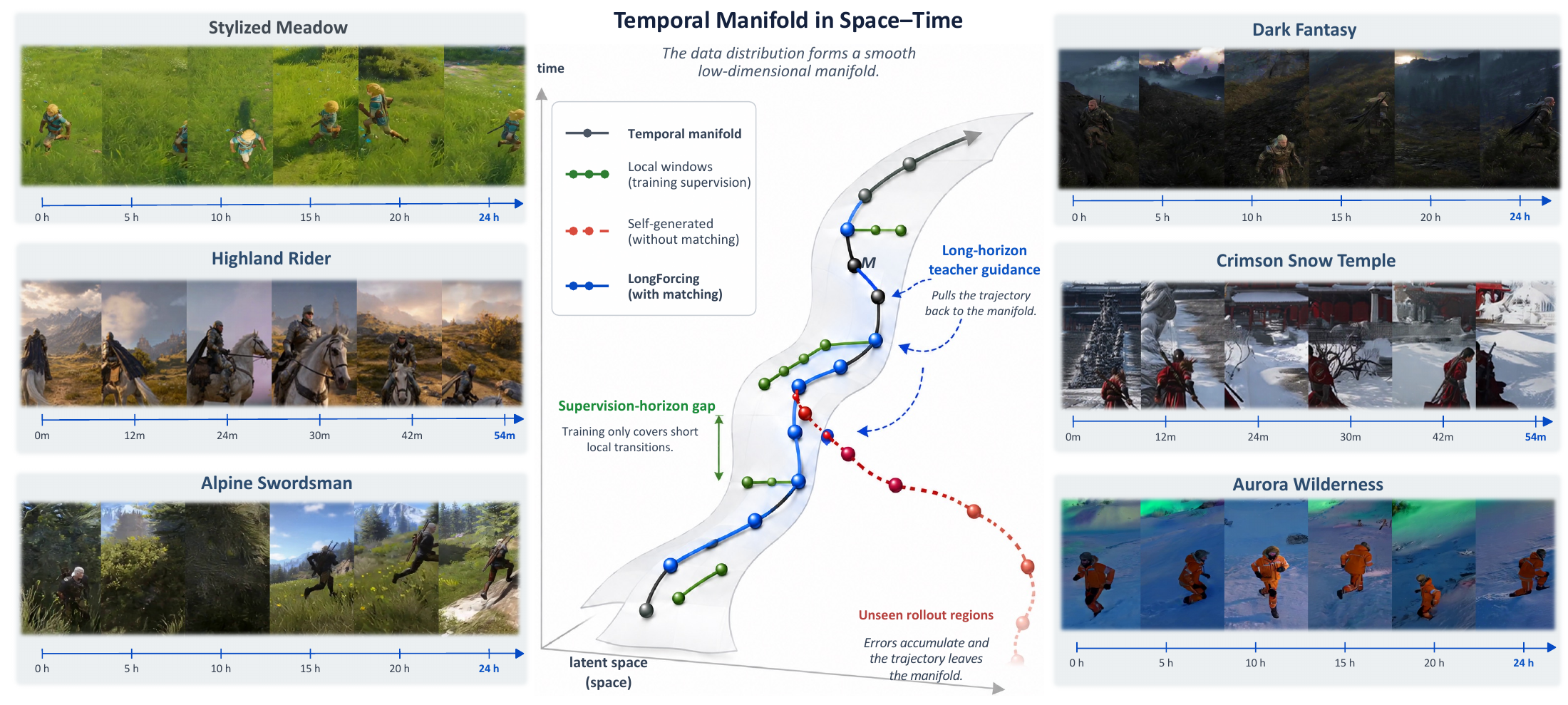
Browse the 24-hour rollout cases in our interactive viewer.
Sparse samples from qualitative stress tests; quantitative evaluation is reported separately above.
THEORETICAL PERSPECTIVE
Perfect local-window matching need not determine the long trajectory distribution.
Longer on-policy rollouts reveal failures whose first hitting time lies beyond the short horizon.
Drift depends on teacher leakage, on-policy mismatch, and whether the rollout can return from failure states.
05 / PAPER
Scaling Temporal Manifold Matching for Long-Horizon World Rollout
@misc{longforcing2026,
  title  = {LongForcing: Scaling Temporal Manifold Matching
            for Long-Horizon World Rollout},
  author = {Zhu, Ziyu and Sun, Zhaoxu and Jiang, Fan and
            Wang, Mengchao and Ni, Junfeng and Xu, Ting-Bing and
            Liu, Zhicheng and Xu, Mu},
  year   = {2026},
  eprint = {2610.18289},
  archivePrefix = {arXiv},
  primaryClass = {cs.CV},
  doi    = {10.48550/arXiv.2610.18289},
  url    = {https://arxiv.org/abs/2610.18289}
}